
9.1.2Trouble in Paradox
More Infinite Geometric Series
Let
SOME INFINITE SUM PARADOXES
In the 18th century, much work was done with infinite series. Instead of infinite sums of numbers, mathematicians worked with “infinite polynomials” such as:
Since they regarded such infinite polynomials as being almost the same as infinite series, they were not prepared to face the unexpected problems that infinite series present. When difficulties arose, however, it caused mathematicians to stop and reconsider.
To illustrate these “problems,” consider the infinite geometric series:
Explain why this series is geometric.
Use your method from problem 9-18 to calculate the sum,
. The sum you computed in part (b) is problematic because the formula
will only work if the sum is finite. With your team, discuss ways to restrict the values of in order to guarantee a finite sum.
TROUBLE IN PARADOX
Asa and his teammates are examining the infinite geometric series
Asa grouped the terms like this:
What value does he get for ? Bianca grouped her terms this way:
What value does she get for ? Charles has a different idea. He uses the formula
, hoping not to get a negative value. What value does he get for ? Based on your observation, does the sum exist? Explain.

Sum of Infinite Geometric Series
Every series has two associated sequences, the sequence of terms and the sequence of partial sums. For example, the series
We can use this series to generate a different sequence: the sequence of partial sums. Its first four terms are:
Note that
In this example,
Consider the infinite geometric series
Though cumbersome, determining the limit of the sequence of partial sums is useful because, unlike using the formula
Write a rule for the sequence of partial sums,
, in terms of . Evaluate
. Explain why this limit demonstrates that the sum of the series does not exist.

If
Betsy accelerated quickly from a stop sign at the freeway entrance. A table of her velocity is shown below. Approximate how far she went in the first
Time (sec) | Vel. (ft/sec) |
|---|---|
A square plot of land

If a hole is punched in the bottom of a tall open can, the rate at which liquid leaks out is roughly proportional to the square root of the depth of the remaining liquid. Unfortunately, Jose’s pesky little brother just used a pen to punch a hole in the bottom of his
.png)
No calculator! Write and evaluate an integral expression to calculate the volume generated when the region bounded by
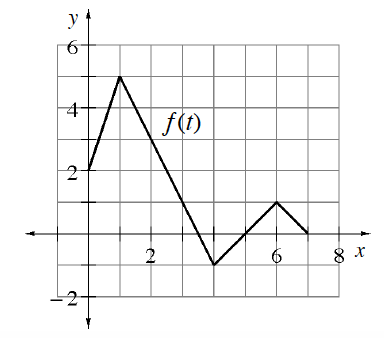
No calculator! Find the interval(s) over which
CALCULATING PARTIAL SUMS FOR AN INFINITE GEOMETRIC SERIES
We can use the method for determining the sum of an infinite series to calculate finite partial sums. Finish the work below. Your end result should be
An alternating series, such as
What is the common ratio for
? Calculate the sum of this infinite series.


